All Core Developers
Glamsterdam targets Hoodi on 15 December
Ethereum’s client teams agreed to keep Glamsterdam’s gas repricing unchanged. They are targeting 15 December 2026 at 19:12 UTC for Hoodi, the final public test network before mainnet. That is a target, not a confirmed activation: client releases still need to ship. No mainnet date has been set.
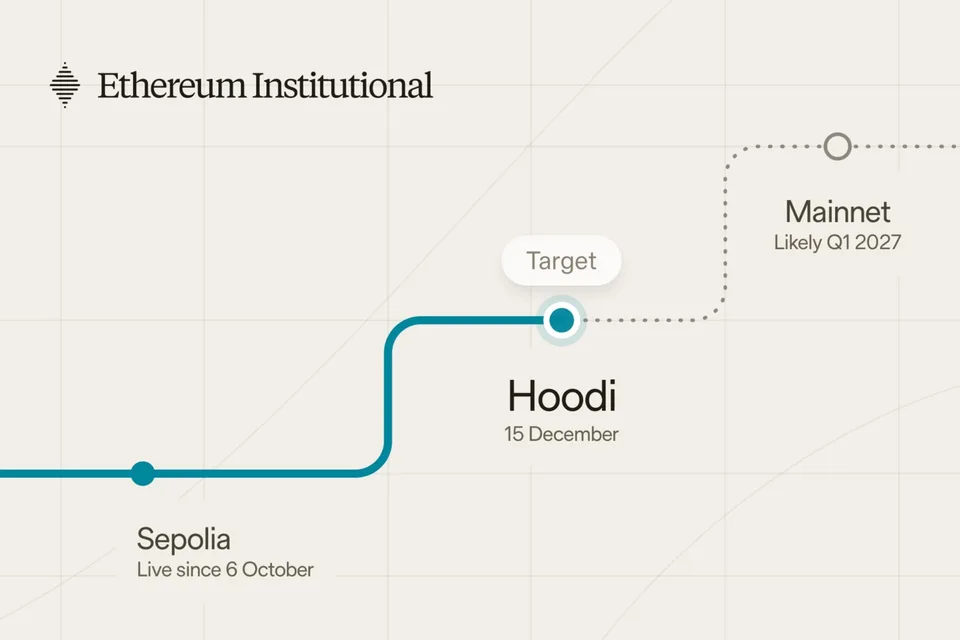
Where Glamsterdam stands
Mainnet rules have not changed.
- SepoliaLive since6 October 2026
- HoodiNo date setTarget15 December 2026, 19:12 UTCPending client releases18 daysafter this call
- MainnetLikely Q1 2027
Upgrade tracker
Developers put the earliest possible date at mid-January 2027 and consider late January or early February more realistic.
| Upgrade | What it delivers | Where it stands | Next milestone |
|---|---|---|---|
| Glamsterdam | Scaling: parallel transaction processing, proposer-builder separation built into the protocol, and gas costs that better reflect resource use | Live on Sepolia since 6 October. Teams agreed not to reopen gas repricing. | Client releases targeted for the week of 30 November; Hoodi on 15 December, 19:12 UTC. Mainnet not scheduled: mid-January at the earliest, late January or early February more realistic. |
| Hegotá | Censorship resistance (FOCIL) and new transaction types that prepare accounts for post-quantum signatures | FOCIL remains in scope, but most teams now lean toward deferring it until after post-quantum work. | The 10 December consensus call aims to settle Hegotá’s scope, including FOCIL. |
What institutions should do now
Test production workflows on Sepolia using the gas limits you use today.
Start with contracts that measure how much gas remains before and after another contract call: developers flagged that pattern as one that can fail under the new rules.
More than 50 affected companies have been contacted; the most severely affected have fixed or will fix by mid-December, and the rest expect to be ready by 10 January.
The teams believe they have identified the affected projects, but acknowledge they could have missed some.
Check how transaction gas limits are estimated.
If an external node or wallet provider supplies the estimate, confirm that its estimator handles the new state-creation costs and test a representative transaction on Sepolia.
The immediate issue for signing workflows is the gas limit attached to a transaction, not a change to the signature itself.
Prepare to update both the execution client and the consensus client once compatible releases ship, and confirm the versions running on each Hoodi node before 15 December.
The December deadline concerns Hoodi infrastructure, not mainnet validators.
What developers decided on Glamsterdam
The main question was whether to change EIP-8037, which raises the gas cost of creating persistent state, such as a new account or storage entry. Repricing can cause an existing contract call to exhaust a gas allowance that was sufficient under the old rules. Teams considered changes to reduce that risk, but none was strong enough to justify delaying the upgrade into 2027, and no client team blocked shipping as specified. The decision was to retain the repricing, not to declare every existing contract unaffected.
Consensus-layer teams also closed the last open technical fix in a way that avoids disrupting Sepolia, where Glamsterdam is already running, and the specification release Hoodi depends on was published the same day.
What remains open for Hegotá
FOCIL would let a rotating committee of validators identify transactions for inclusion in a block when those transactions remain valid and space permits. Its purpose is to make it harder for a block producer to exclude a transaction. The dispute is about sequencing: would delivering FOCIL consume the same specialists needed to move Ethereum toward cryptography that can withstand future quantum computers?
Supporters argue that FOCIL is largely engineering work that can proceed while post-quantum research continues. Others argue that if post-quantum security is the priority, FOCIL should wait, because both depend on the same small group of specialists. Participants asked for a clear account of which post-quantum work FOCIL would actually delay.
The balance appears to have shifted: an informal show of positions on the call suggests most client teams now lean toward deferring FOCIL until after post-quantum work, with a few open to a minimal version. Removing a headline feature is arguably something that should have near-unanimity, so FOCIL stays in scope until the 10 December call.
The urgency comes from the updated post-quantum roadmap presented on the 12 November consensus call: the aim had been for Ethereum to be post-quantum ready by 2029, but a new proposed target aims for readiness in 2027. A separate proposal recommends Keccak-256, a hash function Ethereum already uses, for future hash-based post-quantum cryptography. It remains open for comment and does not change wallet or custody signing requirements.
Ethereum Institutional’s view. Treat Glamsterdam as a testing and operations matter now, and plan around late January or February rather than an assumed mainnet date. Treat Hegotá as a roadmap decision. The signal to watch on 10 December is whether FOCIL is deferred, and whether teams identify a specific dependency that requires one effort to wait for the other.
What to watch
- Client releases for Hoodi.
- Execution-layer call (ACDE #250).
- Consensus-layer call (ACDC); Hegotá scope and the FOCIL decision.
- Glamsterdam activates on Hoodi.
- Mid-December 2026High-severity affected projects fixed.
- Medium-severity affected projects ready.
- Late January to early February 2027Likely Glamsterdam mainnet window (mid-January at the earliest); not yet scheduled.
Sources
- 1All Core Devs, ACDC #192 agenda.
- 2All Core Devs, ACDC #192 transcript and chat.
- 3Forkcast, ACDC #191 summary, 12 November 2026.
- 4Forkcast, ACDE #249 summary, 19 November 2026.
- 5Forkcast, ACDC #192 summary, 26 November 2026.
- 6Forkcast, Glamsterdam Upgrade.
- 7Forkcast, Hegotá Upgrade.
- 8All Core Devs, Glamsterdam upgrade plan.
- 9All Core Devs, Glamsterdam deployments.
- 10Ethereum Consensus Specifications, Verify the payload’s block hash in envelope gossip validation (#5770), 26 November 2026.
- 11Ethereum Consensus Specifications, v1.7.0-beta.5, 26 November 2026.
- 12Ethereum Improvement Proposals, EIP-8037.
- 13Ethereum Improvement Proposals, EIP-7805.
- 14ChainSecurity, EIP-8037 and EIP-8038 impact assessment. Shared on ACDE #249.
- 15Ethereum Foundation, PQAI #0: Preparing Ethereum for a post-quantum, post-AI world, 23 November 2026.
- 16Ethereum Foundation, PQAI #1: One hash to rule them all, 24 November 2026.
- 17Ethlabs, Ethereum Magicians, An Ethlabs view on post-quantum and post-AI timelines: pqai27, 11 November 2026.
- 18Ethlabs, Tracking the Glamsterdam discussion, 10 November 2026.
- 19Ethlabs, Ethlabs’ position on Glamsterdam, 25 November 2026.